
Explore Fixed Full-Arch Replacement Teeth
All-on-4 and Full-Mouth Dental Implants
Discuss full-arch restoration with an independent dental provider. Get a Free Estimate
Full-arch dental implant treatment is designed to replace an entire upper or lower row of teeth using a restoration supported by multiple implants. It may be considered by people who have lost most of their teeth or whose remaining teeth cannot be predictably maintained.
All-on-4 is a particular full-arch treatment concept that uses four implants to support a complete arch of replacement teeth. Other full-arch approaches may use additional implants depending on bone availability, bite forces and the intended prosthesis.
We accept requests from people interested in understanding fixed full-mouth tooth replacement. The contractor evaluates whether a full-arch approach is appropriate and whether existing teeth should be preserved.

Replacing an entire arch requires coordination between surgical planning and the design of the replacement teeth. Each stage contributes to the function, appearance and maintainability of the final restoration.
Planning begins with an assessment of the remaining teeth, gum tissues and jawbone. The provider considers the relationship between the upper and lower jaws, the available restorative space and the position of important anatomical structures. These findings influence how many implants may be needed and where they can be placed. Some full-arch designs use angled posterior implants to make use of available bone and reduce unsupported extensions of the restoration. This approach may reduce the need for grafting in selected patients, but it does not eliminate grafting requirements in every case. The final design should reflect individual anatomical and functional needs.
Patients with severely damaged or unstable remaining teeth may require extractions as part of their full-arch treatment. However, removing teeth is irreversible, and the provider should explain why preservation is not considered appropriate before proceeding. An additional opinion can be helpful when the proposed treatment involves extensive extractions. Some patients qualify for a temporary fixed restoration attached around the time of implant placement. This depends on initial implant stability and other clinical factors. Immediate temporary teeth do not mean the implants have completed their healing process. Dietary restrictions and careful monitoring may still be necessary during the integration period.
After the initial healing period, the dental provider reassesses implant stability and the surrounding tissues. Measurements, impressions or digital scans may be used to design the definitive restoration. The final teeth should account for speech, lip support, chewing function and the relationship between both arches. Full-arch prostheses can be constructed using different materials and supporting frameworks. Their design influences weight, appearance, repairability and cleaning access. Ask the contractor to explain the proposed material and why it is appropriate for your bite and lifestyle. The ability to maintain the restoration should be considered alongside its appearance.
Recovery after full-arch surgery varies with the extent of the procedure and the patient's health. Temporary changes in speech, swelling and dietary limitations may occur. The treating professional provides individualized instructions and determines when chewing forces can safely increase. A fixed full-arch restoration cannot be removed at home for cleaning. Patients need to learn how to reach the space between the prosthesis and the gums using suitable cleaning aids. Professional examinations remain necessary to monitor tissue health, implant stability and restorative components. Ask how maintenance visits and potential repairs will be handled over the life of the restoration.
Your request can begin a discussion about four-implant concepts and other configurations that may be appropriate.
The contractor can clarify which restoration is intended for healing and which will serve as the definitive replacement.
Discuss cleaning access and future servicing before choosing a fixed full-arch prosthesis.
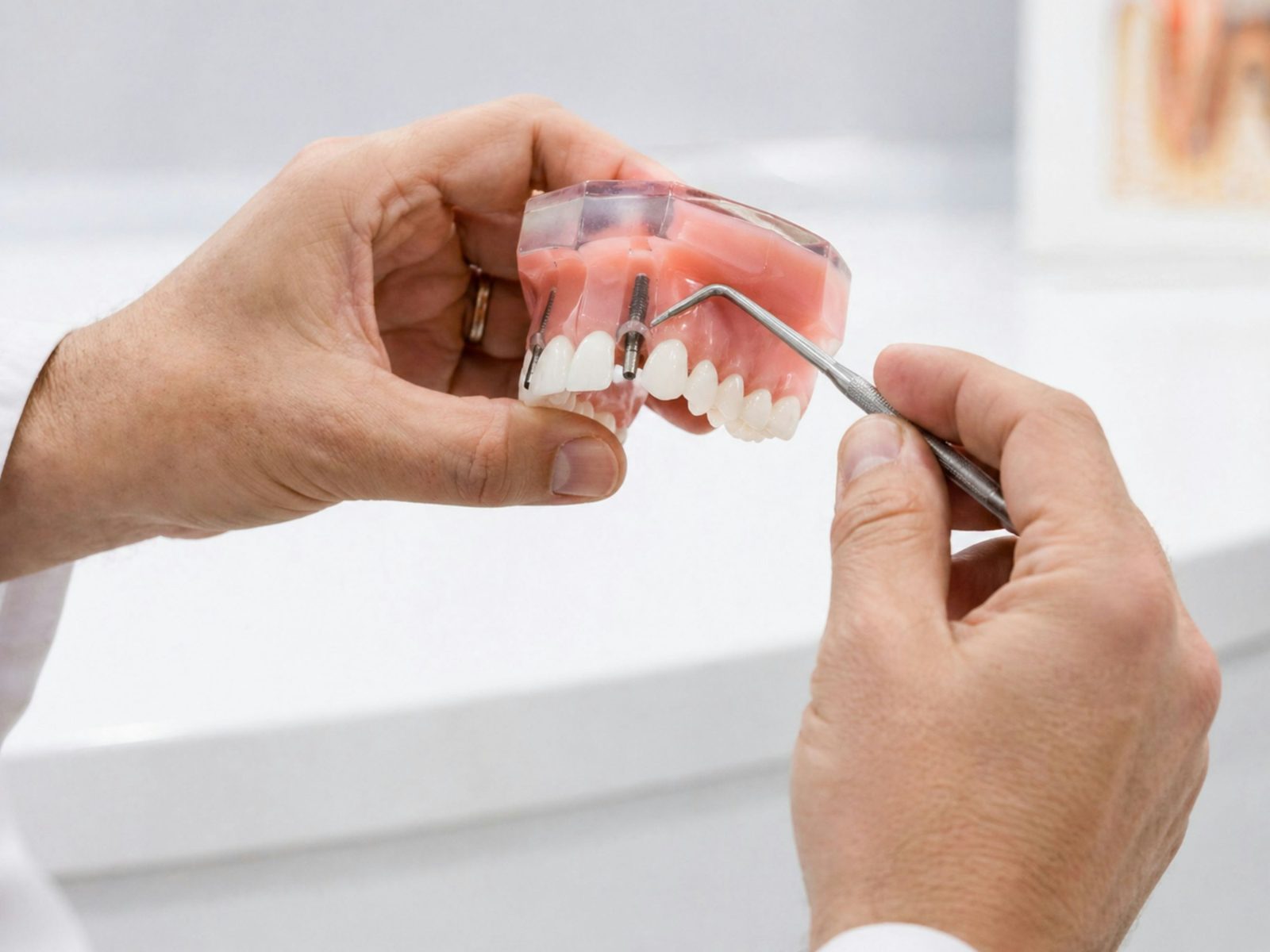
Find out whether fixed full-arch replacement teeth may be suitable for your situation.
Free — no obligations
Explain whether you currently wear complete dentures, have failing teeth or are missing most of the teeth in one or both jaws.
The contractor reviews your medical background, examines the mouth and determines which diagnostic records are needed.
Review the number of implants, extraction requirements, temporary tooth options and expected treatment stages.
The treating professionals perform the planned procedures and monitor healing according to your individual circumstances.

The All-on-4 concept uses four implants to support one complete dental arch. Replacing both arches requires separate planning for the upper and lower jaws.
Immediate temporary fixed teeth may be possible when adequate implant stability and other clinical requirements are achieved. Some patients need a different temporary arrangement while healing takes place.
No. Teeth that can be maintained should be considered carefully before extraction, and some patients may benefit from a less extensive restoration.
Many restorative problems can be repaired or addressed by replacing particular components. The available options depend on the prosthesis material, design and nature of the damage.